

What is education Loan?
An education loan for studying abroad is money that a student borrows from a bank or financial institution to pay for their education in another country.
In simple words: It’s like borrowing money to go to college or university in a foreign country, and then paying it back later—usually after you finish studying and start working.
What it usually covers:
- Tuition fees (college costs)
- Examination and library fees
- Internship or training fees, if part of the course
- Purchase of books, equipment, and uniforms
- Accommodation and living expenses (like rent, food)
- Travel expenses related to the course (including airfare for studying abroad)
- Other course-related expenses approved by the lender
Types of Education Loans
Based on Lender
a) Bank Loans ( Public or Private Banks )
Offered by national and private banks (e.g., SBI, ICICI, HDFC)
Often have lower interest rates for government banks
May require collateral for higher amounts
b) NBFC Loans ( Non-Banking Financial Companies )
b) NBFC Loans (Non-Banking Financial Companies)
Private financial companies (like HDFC Credila, Avanse, InCred)
Faster processing but usually higher interest rates
More flexible with documents
c) International Leaders
Lenders based outside your home country (like Prodigy Finance, MPOWER Financing)
No need for collateral or co-signer in some cases
Useful for students going to top universities abroad
NBFC Loans (Non-Banking Financial Companies)
Private financial companies (like HDFC Credila, Avanse, InCred)
Faster processing but usually higher interest rates
More flexible with documents
International Lenders
Lenders based outside your home country (like Prodigy Finance, MPOWER Financing)
No need for collateral or co-signer in some cases
Useful for students going to top universities abroad
Based on Collateral
a) Secured Education Loan (With Collateral)
A secured education loan requires you to pledge a valuable asset as collateral to the lender. This asset could be immovable property, fixed deposits, life insurance policies, or government bonds. This type of loan typically comes with lower interest rates and allows for higher loan amounts, making it a suitable option for funding expensive courses, especially abroad
b) Unsecured Education Loan (Without Collateral)
An unsecured education loan requires no collateral but usually has higher interest rates and stricter eligibility, including strong academics, admission to top universities, and a co-applicant with stable income.
Based on Course Type
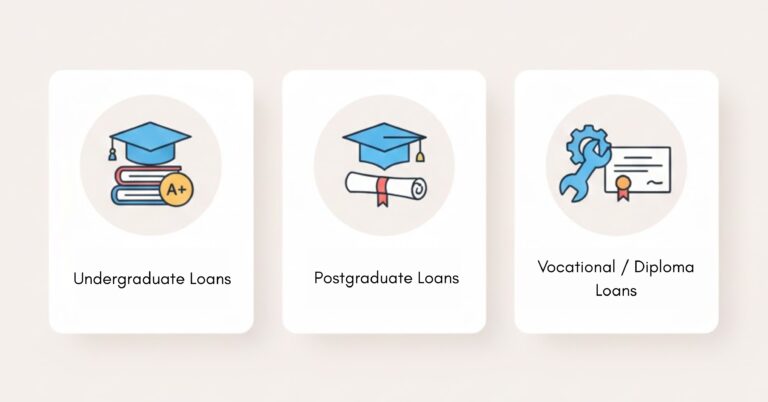
a) Undergraduate Loans
Undergraduate loans help finance bachelor’s degrees abroad, covering tuition, living, and travel expenses. Loan approval and amount depend on parents’ income, co-applicant’s creditworthiness, and financial background.
b) Postgraduate Loans
Postgraduate loans are designed for students pursuing master’s degrees, MBAs, MS programs, and similar courses abroad. These loans are generally easier to get approved if you have admission to a reputed or well-known university, as lenders consider this a lower risk.
Vocational or Diploma Course Loans
Vocational or diploma course loans support students pursuing short-term, skill-based programs abroad, usually lasting a few weeks to a year. These loans offer limited funding and fewer lenders. Examples include digital marketing certificates, hospitality diplomas, language courses, technical training, and professional certifications focused on practical skills and quick career growth.
Vocational loans fund short-term skill-based courses abroad, like digital marketing, hospitality, language, and technical training. They offer limited funding and fewer lenders.
Education Loan Eligibility Criteria (for Studying Abroad)
Student Eligibility
- Nationality: Must be an Indian citizen.
- Age: Generally, between 16 and 35 years (may vary by lender and course).
- Academic Record: Should have a good academic background.
- Admission: Must have confirmed admission (or conditional offer) from a recognized foreign institution.
- Course Type: Should be a graduate, postgraduate, diploma, or professional course, recognized by UGC, AICTE, or equivalent global bodies.
Co-Applicant / Guarantor Eligibility
- Who Can Be a Co-Applicant: Typically a parent, guardian, or spouse.
- Age of Co-Applicant: Generally between 21 and 70 years.
- Income: Must have a stable and regular income to show repayment ability.
Course and Institution Criteria
- Recognized Institution: The university/college abroad must be accredited and accepted by the relevant government or international bodies.
- Eligible Courses: Focus on professional and technical programs, such as:
- Engineering
- Medical
- Management (MBA)
- Computer Science
- Other career-oriented fields
