
INTRODUCTION
Planning to study abroad can feel overwhelming, but breaking the process into smaller steps makes it much more manageable. Here’s a complete roadmap for Indian students studying abroad—whether you’re looking at international studies after 12th or foreign studies for Indian students after graduation in India.
Step-by-Step Application Process to Study Abroad for Indian Students
Here are some of the job-oriented abroad courses for Indians that are globally in demand and lead to strong career growth:

1. Research and Selection.
The first step in the study abroad process for Indian students is research.
- Choose your destination – Top choices include the USA, UK, Canada, Australia, Germany, and Singapore. Consider factors like tuition fees, cost of living, quality of education, and post-study work opportunities.
- Pick the right course – Align your program with your academic interests and long-term career goals. Popular options for education abroad for Indian students include Engineering, Computer Science, Business Administration, Medicine, and Law.
2. Check Requirements & Prepare
Every country and university has its own admission process. Make sure you’re fully prepared:
- Academic eligibility – For how to study abroad from India after 12th, most universities expect at least 70% in board exams. For global education for Indians at the postgraduate level, you’ll need a bachelor’s degree with strong grades.
- Entrance exams – Depending on your destination, you may need to take IELTS, TOEFL, PTE, SAT, ACT, GRE, or GMAT.
- Documents – Prepare transcripts, a Statement of Purpose (SOP), Letters of Recommendation (LORs), updated resume, valid passport, and financial proof to support your application.
3. Apply for Admission.
Once you’ve shortlisted abroad universities for Indian students, the next step is applying.
- University applications – Apply directly through university websites or via centralized portals.
- Scholarships & aid – Many abroad universities for Indian students provide scholarships and financial aid to reduce study costs.
- Confirm admission – After receiving an offer letter, secure your admission by paying the required deposit.
4. Students Visa & Departure.
Once your admission is confirmed, start preparing for the move.
- Visa application – Apply for a student visa with your offer letter, academic documents, and proof of funds.
- Accommodation – Choose between on-campus housing, private apartments, student hostels, or homestays based on your budget and preferences.
- Travel preparation – Book your flight tickets, arrange health insurance, and attend university orientation sessions to settle in smoothly.
Students with an interest in travel, luxury, and customer service can consider hospitality management. Abroad universities in Switzerland, Canada, and Australia are global leaders in this field, making it one of the best courses to study abroad for Indian students who love people-centric careers.
Popular Courses for Indian Students Abroad

Engineering
Engineering remains one of the most popular choices among Indian students studying abroad due to global demand and rewarding career prospects. Top branches include Mechanical, Civil, Electrical, Biomedical, Aerospace, and Environmental Engineering.
Computer Science
With rapid technological growth, Computer Science degrees are in high demand worldwide. For those planning international studies after 12th or postgraduate specialization, this field offers strong career potential. Undergraduate courses build IT foundations, while postgraduate programs allow specialization in areas like AI, algorithms, and web technology.
Information Technology (IT)
IT is a booming field worldwide. A B.Sc. in IT covers databases, software, and networking, blending practical applications with theoretical foundations. It is also a strong career path under global education for Indians, opening doors to worldwide opportunities.
Medicine
Medical degrees such as MBBS, MD, and DO are prestigious and demanding. Programs often span 4–6 years, with options for specialization and research opportunities
Law
Law degrees prepare students for careers in national and international legal systems. Specializations include Human Rights, Intellectual Property, Environmental Law, and International Law.
Social Sciences
Fields like Economics, Political Science, Psychology, and Sociology help students understand societies and human behavior, offering careers in research, policy, and academia.
Hospitality & Tourism
Degrees in Hotel and Tourism Management open opportunities in hospitality industries worldwide. Programs cover cross-cultural management, leadership, and professional skills.
Accounting
Accounting degrees prepare students for careers as auditors, financial analysts, or chartered accountants, with strong global career demand.
Fashion Design
Fashion and design courses such as B.Des. are gaining popularity among Indian students studying abroad. These programs explore creativity, design technology, and innovation in the fashion industry
Checklist for Choosing the Best University Abroad
- Define your goals: Be clear about your academic and career objectives.
- Check rankings: Consider both global and subject-specific rankings to evaluate universities.
- Cost of study: Compare tuition fees and living expenses to fit your budget.
- Understand the education system: Academic structures vary across countries like the USA, UK, and Australia.
- Facilities & research: Ensure the university offers modern infrastructure, libraries, labs, and student support.
- Career prospects: Look into placement services, internships, and global recognition of degrees.
Top Global Universities Preferred by Indian Students
Some of the top-ranked abroad universities for Indian students include:
- Massachusetts Institute of Technology (MIT), USA
- Stanford University, USA
- University of Oxford, UK
- University of Cambridge, UK
- Harvard University, USA
- University of Toronto, Canada
- The University of Melbourne, Australia
- ETH Zurich, Switzerland
These institutions consistently rank high in QS World Rankings and attract thousands of Indian students studying abroad every year.
Top Benefits of Studying Abroad
Studying abroad is more than just academics—it shapes your personality, skills, and career. Here are the biggest advantages for Indian students studying abroad:
- Global Learning Experience – Exposure to new teaching styles and diverse education systems.
- Travel Opportunities – Explore new cities, cultures, and tourist destinations during your free time.
- Cultural Immersion – Experience new cuisines, festivals, and lifestyles.
- Networking & Friendships – Meet people from different countries and build lifelong relationships.
- Language Skills – Learn or improve a foreign language, which also boosts employability.
- Independence – Manage your own finances, meals, and lifestyle—making you self-sufficient.
- Career Boost – International degrees and experiences are highly valued by global employers and support global education for Indians.
- Internship Opportunities – Gain practical exposure in multicultural environments.
- Skill Development – Enhance technical, analytical, and communication skills.
- Personal Growth – Become more adaptable, confident, and globally aware.
Essential Documents for Studying Abroad

For a smooth study abroad process for Indian students, these documents are a must:
- Application Form & SOP – With motivation letter/essay.
- Academic Records – 10th, 12th, graduation mark sheets & certificates.
- Entrance Exam Scores – IELTS, TOEFL, GRE, GMAT, SAT (as required).
Minimum English Test Scores for Indian students studying abroad:
- USA: IELTS 6.0–6.5 | TOEFL 61–80
- UK: IELTS 6.0–7.0 | TOEFL 92–100
- Canada: IELTS 6.5–7.0 | TOEFL 80–100
- Germany: IELTS 6.0 | TOEFL 85–100
- Australia: IELTS 6.0–6.5 | TOEFL 79–110
- ID Proofs & Photos – Passport, PAN/Aadhaar, passport-size photos.
- LORs & Resume – From professors/supervisors plus updated CV.
- Financial Proof – Bank/loan papers, scholarships, or sponsor details.
- Travel & Health Docs – Visa, medical certificates, vaccination, insurance.
10 Common Mistakes Students Make (and How to Avoid Them)
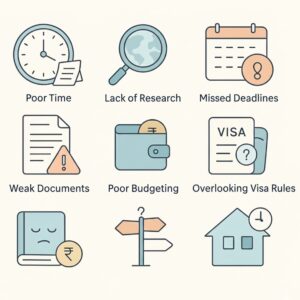
Applying to foreign studies for Indian students is exciting—but even small mistakes can cost you opportunities. Here are the most common pitfalls and practical ways to avoid them:
- Relying on Wrong Advice – Avoid unverified sources. Seek guidance from trusted counsellors or official university resources.
- Choosing the Wrong Course – Pick programs based on your interests and career goals, not just popularity.
- Random University Shortlisting – Research thoroughly and shortlist based on eligibility, budget, and academic fit.
- Ignoring Academic Prerequisites – Check program-specific requirements like prerequisite subjects or coursework.
- Late Exam Registration – Book GRE, GMAT, IELTS, or TOEFL well in advance.
- Delaying Scholarship Applications – Apply early, as deadlines often come before admissions.
- Applying to Limited Universities – Apply to a balanced mix of ambitious, target, and safe options.
- Poor Interview Preparation – Practice interview questions and research your chosen program.
- Generic SOPs and LORs – Personalize each application to reflect genuine interest.
- Last-Minute Submissions – Submit early to avoid technical glitches and incomplete applications.
Visa Process for Indian Students

Each country has its own visa requirements. Here’s a quick breakdown for popular destinations:
USA
- F-1 Visa: For full-time academic study.
- J-1 Visa: For exchange programs.
- Requirements: Admission to SEVP-approved institution, financial proof, English proficiency, intent to return.
CANADA
- Study Permit: Equivalent to a student visa.
- Requirements: Acceptance from a DLI, proof of funds, possible medical exam, and a letter of explanation.
UK
- Student Visa (formerly Tier 4).
- Requirements: CAS from a UK university, financial proof, English proficiency, and Immigration Health Surcharge.
AUSTRALIA
- Subclass 500 Visa.
- Requirements: CoE, Genuine Temporary Entrant (GTE) statement, proof of funds, OSHC, and English proficiency.
GERMANY
- National Visa (D Visa).
- Requirements: Admission letter, blocked account (minimum €11,208/year), health insurance, and language proficiency.
Cost of Living Abroad for Indian Students: Country-Wise Guide
Accommodation Options Abroad for Indian Students

Finding suitable accommodation is vital for Indian students studying abroad, ensuring comfort, safety, and easy transition. Whether exploring how to study abroad from India after 12th or abroad studies after graduation in India, housing is a key step in the study abroad process. Common Options for Indian Students Studying Abroad
- On-Campus Housing – Convenient, community-driven, great for first-year Indian students studying abroad, though limited in availability.
- Off-Campus Apartments – Offers independence and flexibility but requires proper research to avoid scams.
- Homestays – Living with a local family helps cultural immersion and language learning—ideal for international studies after 12th.
Student Hostels/Co-Living Spaces – Affordable, student-friendly with shared facilities; popular for foreign studies for Indian students seeking budget options
Tips for Finding the Best Accommodation Abroad
- Start early – Housing at abroad universities for Indian students fills quickly.
- Set a budget – Include rent, utilities, transport, and food when planning for global education for Indians.
- Match your lifestyle – Choose quiet vs. social neighborhoods.
- Do thorough research – Use trusted platforms and avoid scams in the overseas education guide
- Review contracts carefully – Check deposits, refund policies, and hidden charges before finalizing.
Safety Tips for Indian Students Abroad
Safety should be a top priority when living in a new country. Here’s how to stay secure:
- Before Departure: Research local laws and culture, secure documents, register with the Indian Embassy, arrange health check-ups, and download safety apps.
- On Arrival: Stay alert in crowded areas, secure your accommodation, protect belongings, and use campus resources.
- During Emergencies: Contact local emergency services first, then inform the Indian embassy and your university.
Pre-Departure Checklist
Before leaving India, make sure you’ve covered these essentials:
- Documentation & Finances – Passport, visa, acceptance letter, travel insurance, budget plan, local currency, and bank account setup.
- Health & Safety – Vaccinations, medical certificates, prescriptions, and health insurance.
- Destination Research – Culture, climate, academic system, and local laws.
- Logistics – Book accommodation and flights, pack smart, and download useful apps.
- Personal Prep – Learn basic local phrases, know emergency numbers, and set up international calling.
Abroad Study Fees for Indian Students: Country-Wise Comparison
Planning your education abroad involves one of the most important factors—tuition fees. To help Indian students make informed decisions, here’s a breakdown of the average annual tuition costs in popular study destinations, shown in both USD and INR
Country | Average Annual Tuition Fees (USD) | Average Annual Tuition Fees (INR) |
United States | $20,000 – $40,000 | ₹17,73,367 – ₹35,46,734 |
United Kingdom | $15,000 – $35,000 | ₹17,82,499 – ₹41,59,165 |
Canada | $15,000 – $30,000 | ₹9,54,073 – ₹19,08,146 |
Australia | $20,000 – $45,000 | ₹11,61,066 – ₹26,12,398 |
Germany | $500 – $2,000 | ₹51,889 – ₹2,07,558 |
France | $3,000 – $5,000 | ₹3,11,337 – ₹5,18,895 |
New Zealand | $20,000 – $30,000 | ₹10,23,927 – ₹15,35,890 |
Singapore | $20,000 – $40,000 | ₹13,73,092 – ₹27,46,184 |
Ireland | $15,000 – $25,000 | ₹15,56,685 – ₹25,94,475 |
Netherlands | $8,000 – $20,000 | ₹8,30,232 – ₹20,75,580 |
Note: Tuition fees may vary depending on the course, university, and location within each country.
Studying abroad is a major investment, but with the right planning, you can balance quality education and affordability. If you’re wondering how to study abroad from India after 12th, compare tuition fees, scholarships, and part-time work options. Understanding the study abroad process for Indian students—from selecting the right university to securing a visa—will make your journey smoother.
When planning international studies after 12th or even postgraduate programs abroad, tuition fees aren’t the only expense—living costs also play a major role. This overseas education guide breaks down the cost of living country-wise to help Indian students budget smartly for their journey toward global education for Indians.
Monthly & Annual Cost Estimates by Country
Country | Avg Monthly Living Cost* | Key Notes |
USA | USD 1,000 – 2,500 / month | Cities like New York, San Francisco, Boston are on the higher end, while smaller towns are more affordable. |
UK | £800 – £1,500 / month | London is much more expensive compared to cities like Manchester or Birmingham. |
Canada | CAD 800 – 2,000 / month | Toronto & Vancouver are pricier; cities like Ottawa and Winnipeg are student-friendly. |
Australia | AUD 1,200 – 2,500 / month | Sydney & Melbourne have higher costs, while smaller cities are relatively affordable. |
Germany | €700 – €1,200 / month | Many public universities charge little or no tuition, making it one of the cheapest options for Indian students. |
France & Other EU Nations | €800 – €1,300 / month | Paris and other capitals are expensive, but small university towns are more affordable. |
For Indian students aiming at international studies after 12th or abroad studies after graduation, knowing the cost of living is as important as choosing the right course or university. With the right planning and the help of an overseas education guide, students can enjoy the benefits of global education for Indians while managing their budgets effectively.
